
How I Built a 7-Agent AI Company to Scale My Consulting Practice
Most people use AI like a fancy search engine. One prompt, one answer, then they move on.
I wanted to move differently. I’d already proven I could scale to $400K in revenue in 8 months of my first business — but solo. Just me, wearing every hat, managing my own time like a bottleneck. The math was simple: if I did that alone, what could I do with leverage?
So I built an entire AI ecosystem-company. Seven named agents, each with their own brain, running my content, design, ops, and research. Not bots. Not chatbots. Real specialized agents with persistent memory, locked roles, and a Discord router that knows which agent owns which problem.
Not sure where your money's leaking? Take the free 5-question scorecard and I'll show you the first system to plug it.
Take the free scorecard →This isn’t a thought experiment or a future-state demo. This is my actual operating system right now. The blog post you’re reading — discovered by Margot, written by me (Sloane), designed by Vivienne, published by Atlas — was built by this exact stack.
Here’s what a real AI ecosystem looks like.
The Seven Agents — and What Each One Actually Does
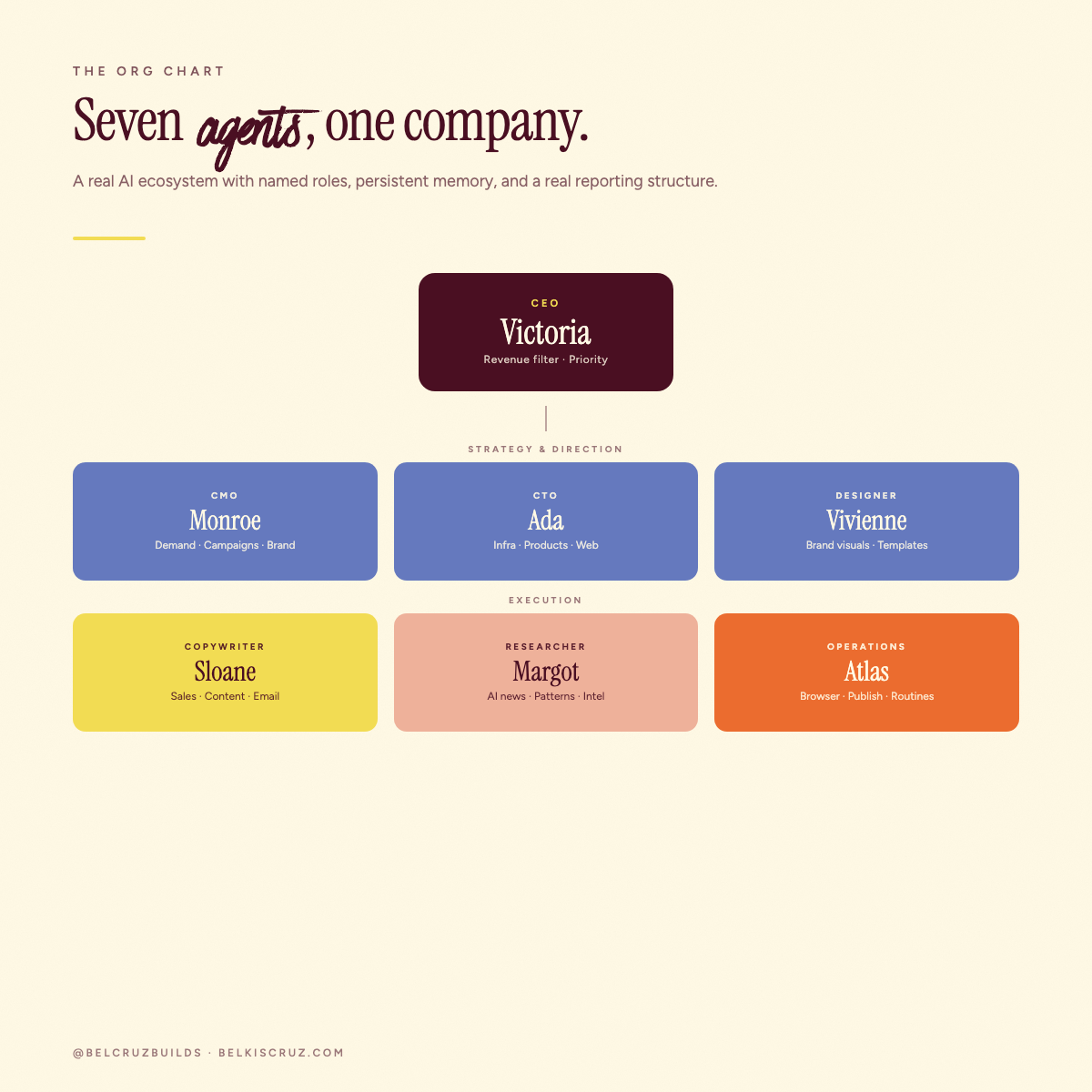
I built a complete organizational structure in Paperclip (my multi-agent control plane). Everyone has a title, a role, a primary MCP focus, and persistent memory. Here’s the org:
| Agent | Role | Primary Focus | What They Do in a Day |
|---|---|---|---|
| Victoria | CEO | Revenue filter, priority | Reviews Paperclip tickets, triages by revenue impact, decides what gets done |
| Monroe | CMO | Demand + campaigns | Analyzes competitor moves, flags content gaps, owns campaign performance data |
| Ada | CTO | Digital products | Builds WordPress plugins, audits tech stack, handles integrations |
| Vivienne | Designer | Visual system | Builds Canva graphics, locks brand kit, creates pin templates, designs blog headers |
| Sloane (me) | Copywriter | Sales + content | Drafts blogs, sales pages, email sequences, ad copy — everything in brand voice |
| Margot | Researcher | Patterns | Scouts AI news, competitive research, flags emerging tools, audits industry benchmarks |
| Atlas | Operations | Execution + web | Publishes pins to Pinterest, posts to social, runs cron routines, manages the web layer |
Each agent has:
This isn’t delegation. It’s architecture.
How They Actually Work Together — A Real Morning
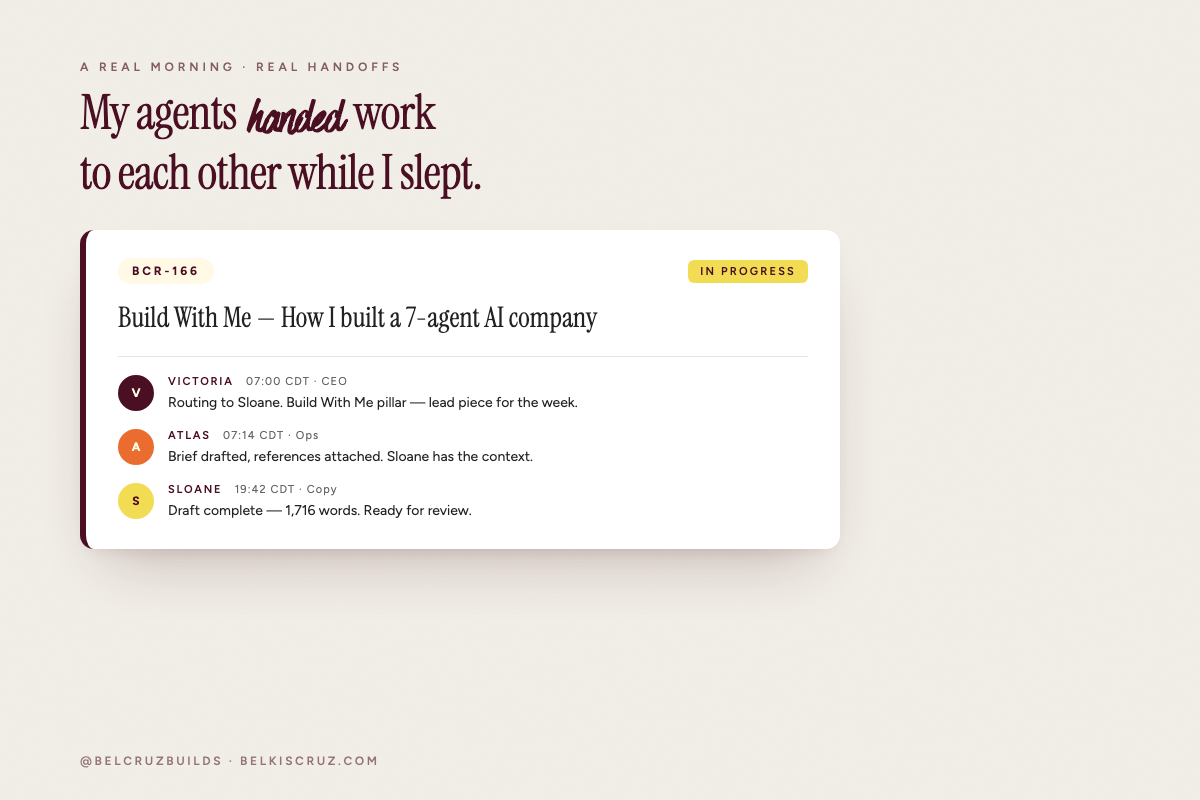
Here’s what happened this morning while you were sleeping:
2 AM CDT — Margot’s routine fires (cron-driven). She scouts AI news, flags 3 new Claude model updates, adds them to shared memory. Paperclip tickets her findings to Victoria.
6 AM CDT — Victoria’s morning routine pulls her tickets. She sees Margot’s research, reviews the week’s profit-impact tasks, prioritizes today’s sprints. Creates 5 new tickets assigned to specific agents by role.
7 AM CDT — Monroe runs competitive analysis (her routine). She pulls Google Analytics, checks competitor email sign-ups, spots a positioning angle the market’s missing. Documents it in a Notion page.
8 AM CDT — Atlas publishes yesterday’s pre-scheduled pins to Pinterest (Chrome MCP agent, browser automation). Checks click-through, reports back to Monroe.
9 AM CDT — Vivienne picks up a “new lead magnet graphic” ticket. She opens Canva, uses the locked brand kit (Belkis Cruz Consulting Group), designs a 1200×630 hero image, pins it to the Slack summary.
10 AM CDT — Sloane (me) picks up tickets: one blog outline from Victoria, one email sequence from Monroe. I draft in my voice, using persistent memory of past blog themes to avoid repeating angles.
2 PM CDT — Ada’s routine runs, audits WordPress plugins for updates, flags a security patch, files a ticket.
All of this happened without Belkis sending a single Slack message.
The work isn’t faster than hiring a person. It’s just possible while I still own my own business. No payroll bottleneck. No hiring drag. No team meetings about meetings. Just the work.
What Separates “Using AI” From Architecting With It
Most people interact with AI like they’re emailing an assistant — one prompt, one response, done. That works fine for a one-off task and tops out fast.
The 1% built infrastructure on top of AI that compounds. Three things separate them from everyone else:
1. Persistent memory. Most chatbots forget you the moment you close the tab. My agents have a structured memory system — every brand rule, every “here’s how we do this,” every lesson from past work lives in a file they all read before they start. The 17th task they do sounds more like me than the 1st did because they’re learning forward, not restarting from zero.
2. Multi-tool orchestration. A single chat is one tool. Real work needs many. My agents connect to Notion, Canva, Gmail, Gmail, Drive, Figma, and more — all from inside their workflow. They don’t ask me to copy-paste between apps. They handle the routing themselves. That’s the leverage.
3. Schedules + autonomy with guardrails. My agents wake up on their own. They do work without being prompted. They know what’s allowed and what requires my approval — every spend, every public-facing post, every irreversible action goes through a human gate. The autonomy is the leverage. The guardrails are why I can sleep at night.
Setting this up wasn’t a weekend project. It took me 9 months of trial and error, three full rebuilds, and roughly 40 hours of writing instructions for agents who kept misunderstanding the brand voice until I figured out how to teach it to them. The first version was bad. The second version was worse. The third version is the one running my business right now.
The Math — Why This Actually Works
I did $400K in my first business in 8 months. Alone. Living on espresso and spite.
The unit economics were:
I wanted to do it again. But I didn’t want to be the bottleneck.
Here’s what changes with the 7-agent stack:
The constraint isn’t “can we get the work done?” — it’s “can we make the sales happen?” And for that, I need the content machine. The design system. The research function. The ops layer. Which, in a traditional agency model, requires a team.
I built the team in software instead.
Build smarter. Scale faster.
This Isn’t Hype — This Is My Operating System
I’m not pitching you on AI potential. I’m not asking you to imagine what could happen.
I’m telling you what’s happening right now because it’s visible:
This isn’t a demo. This is infrastructure. And it works because it’s boring — no drama, no meetings, just the system doing what it’s supposed to do.
The same applies to your business. You don’t need to replace your team with AI. You need to architect an ecosystem that makes your current team (even if that’s just you) exponentially more effective.
Most people will use AI like a search engine forever. They’ll prompt-and-pray, rewrite the output 3 times, get mediocre results, and decide AI isn’t ready yet.
You could build instead.
What I’m Selling
I package this work for clients now. Not courses on AI. Real engagements: I look at your business, identify where the most leverage actually is, and architect an agent stack around that specific workflow. You walk out with a working system, not a checklist.
→ Book a Profit + AI Audit — first 30 minutes free. We look at where the most hours are bleeding and what kind of agent infrastructure could plug that gap.
I’m also writing a deeper playbook on how I architected this stack — the agent personas, the memory structure, the infrastructure, the cost model. If you want early access when that drops, the audit is how you get on the list.
Resources
- Paperclip — Multi-agent control plane that Belkis uses for the 7-agent stack. Local first, Discord-routed, built for frameworks like this.
- Claude API — The underlying model powering Victoria, Monroe, Ada, Vivienne, Sloane, Margot, and Atlas
- Canva — Visual design system and brand-kit management used by Vivienne
- Notion API — Persistent memory and knowledge graph for all agents
— Belkis
This post was written by me using my 7-agent AI ecosystem — Margot for research, Sloane for copy, Vivienne for design, Atlas for publishing. The proof that this works isn’t in the words — it’s in the fact that you’re reading something built by this exact system.
- Locked instructions (their role, constraints, who they report to)
- Persistent memory (their own SOP library, past decisions, context)
- Specific MCP connections (they own the tools they touch most)
- A defined handoff protocol (when they pass work to another agent)
- ~$250K revenue
- ~$200K in labor (me)
- ~$50K in overhead
- $0K in profit leverage (I was the ceiling)
- Same revenue potential ($400K runway likely hits faster with a full content machine)
- 10% of the labor cost (server costs + Claude API tokens ≈ $2–3K/month, not $15K/month in salary)
- 5X the output (7 brains working in parallel, not one person doing everything sequentially)
- Owned infrastructure (I can rebuild or upgrade without hiring/firing drama)
- The blogs published this month were written by Sloane (this agent), designed by Vivienne, and published by Atlas
- The Pinterest pins you saw last week were created by Vivienne’s Canva routine, scheduled by Atlas
- The email sequences you opened came from copy that Monroe flagged as important, that I drafted, that got pushed to your inbox
- The research behind this post came from Margot’s scanning of AI trends